The Complete Link in Bio Guide for 2026
Learn how to build a useful link in bio in 2026: choose the right structure, route visitors by intent and measure the next action that matters.
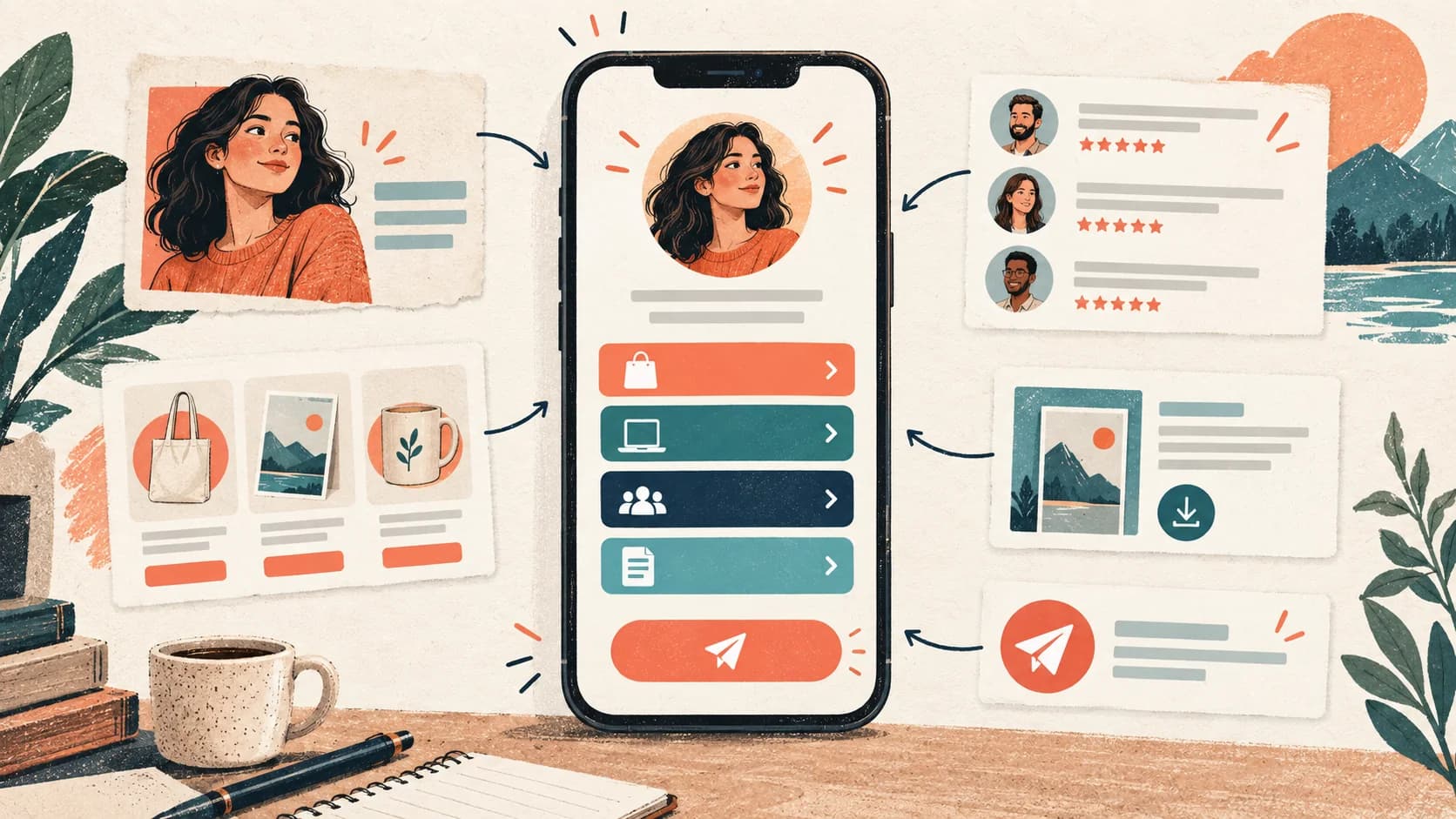
If you're on Instagram, TikTok, or LinkedIn sharing just one link in your bio, you're leaving serious money on the table. In 2026, your link in bio isn't just a link — it's your digital storefront, your sales funnel, and your first professional impression, all rolled into one.
This complete link in bio guide covers everything you need to know: what it is, why it matters more than ever, how to set it up step by step, which tools to use, and — most importantly — how to turn it into a client-generating machine that works for you around the clock.
What you'll learn in this guide
What a link in bio is and why it's your most valuable digital asset · The difference between link in bio and sell in bio · How to set it up step by step · Best practices for 2026 · How to choose the right tool for your professional profile

What Is a Link in Bio?
A link in bio is a lightweight, customizable web page accessible from the single link slot in your social media profile. Platforms like Instagram, TikTok, and Twitter only allow one link in your bio section, making that single URL an incredibly valuable piece of digital real estate.
Instead of constantly swapping that link to point to different destinations — your website, your latest post, your store, your newsletter — a link in bio page centralizes all those destinations in one place. The visitor clicks your bio link, lands on your page, and from there you guide them wherever you want them to go.
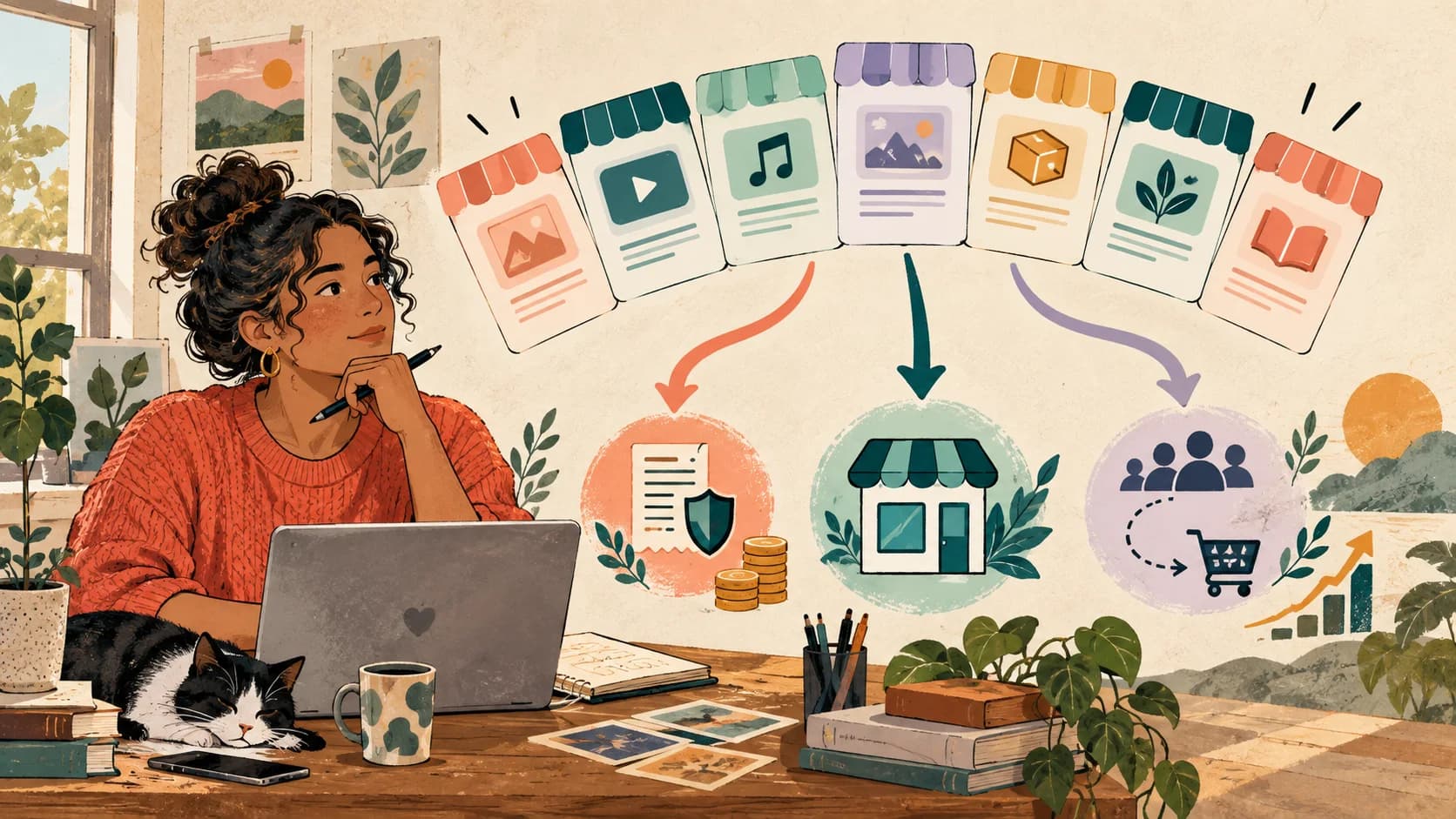
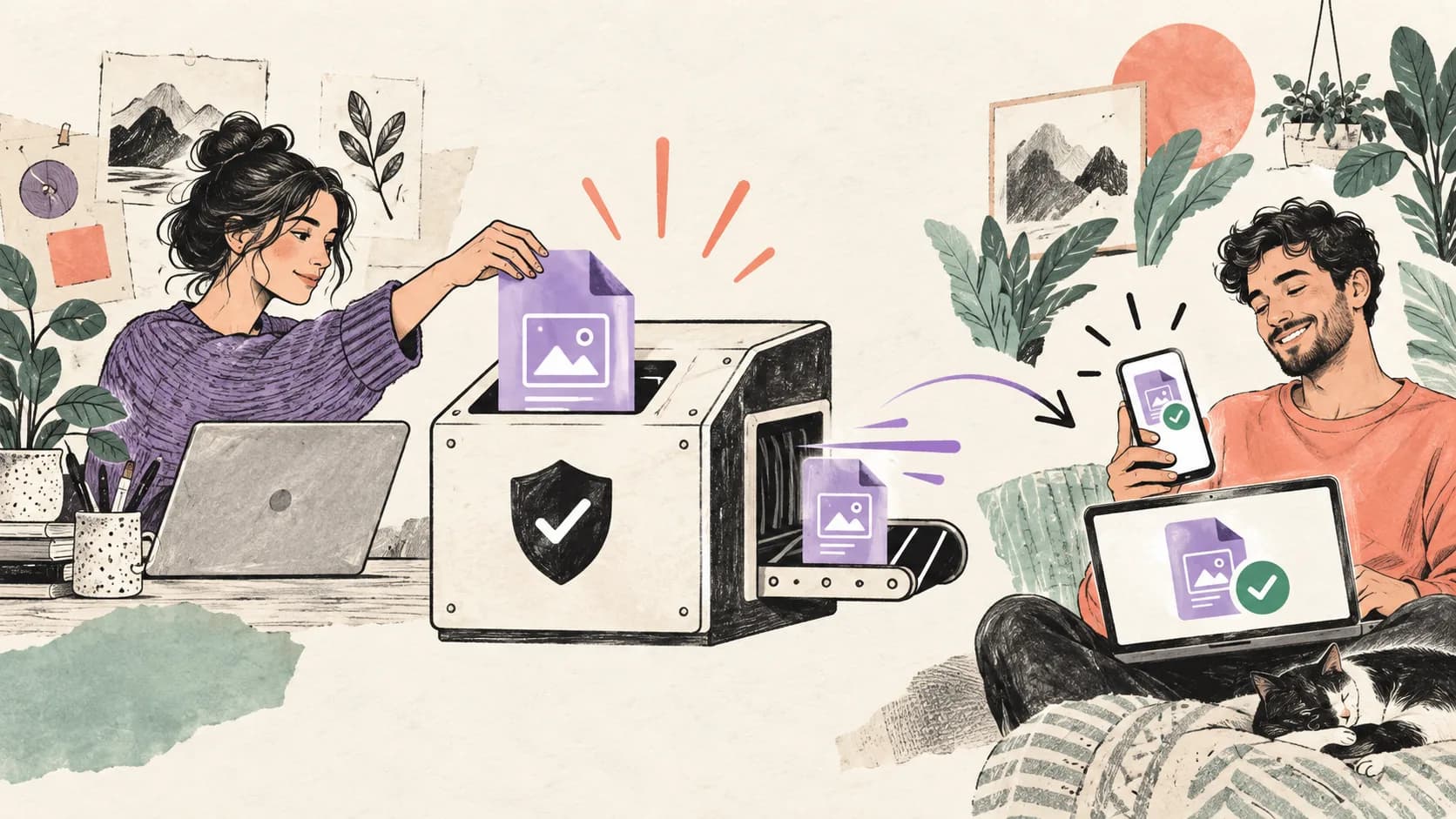
But in 2026, a link in bio that only shows a list of links is like having a store with an empty window display. Modern tools like SellB.io go much further: they let you build conditional funnels, automatically qualify leads, and sell products or services directly from your bio page.
- Centralizes all your digital destinations in a single URL
- Works on Instagram, TikTok, Twitter/X, LinkedIn, YouTube, and any social network
- Is your first professional impression online
- Can act as a sales funnel, lead capture form, or digital store
- Is completely yours: you control it, not the algorithm
Why Your Link in Bio Is Your Most Valuable Digital Asset in 2026
The creator economy is valued at $250 billion globally and is projected to reach $480 billion by 2027, according to Goldman Sachs Research (2023). In this ecosystem, the creators who earn the most aren't those with the most followers — they're the ones who best convert their audience into customers.
And all of that conversion process starts at the link in bio. It's the only touchpoint you completely control within social media. The algorithm can tank your organic reach overnight, but your link in bio is always there, working for you 24 hours a day.
Public benchmarks vary by audience, intent, and measurement method. Use your current conversion rate as the baseline, tag each traffic source, and keep a change only when completed outcomes improve.
The key shift in 2026
Social traffic no longer goes directly to external websites. Algorithms penalize posts with outbound links. The link in bio is the only efficient exit point from social networks, making it the most strategic piece of your entire digital presence.
Link in Bio vs Sell in Bio: The Evolution That Changes Everything
For years, a link in bio was simply a list of links. Tools like Linktree popularized the concept in 2016, and for a long time that was enough. But the market has evolved, and creators who truly convert need something more.
The difference between a traditional link in bio and a sell in bio is the difference between a sign that says "visit us" and a salesperson who qualifies prospects, collects information, and closes deals. SellB.io was designed from the ground up around the sell in bio concept: every element of your page actively works to convert visitors into clients.
| Aspect | Link in Bio | Sell in Bio |
|---|---|---|
| User flow | Shows links, user chooses, leaves | Asks the user, segments them, directs to the right destination |
| Data capture | None | Captures data at every step |
| Personalization | Static, same for everyone | Conditional logic shows different options based on responses |
| Lead qualification | Manual, post-visit | Automatic, built into the flow |
| Integrations | External links only | Direct integration with payments, calendars, and CRMs |
Learn more about this concept
- Link in Bio vs Sell in Bio: The New Concept — Why the traditional link in bio is no longer enough and how sell in bio changes the rules.
- How to Build a Bio Link Funnel — Step-by-step guide to building an effective sales funnel from your bio link.
How to Set Up Your Link in Bio: Step by Step
Setting up an effective link in bio doesn't require technical skills or web design knowledge. But it does require strategy. Many creators make the mistake of adding all their links without thinking about the user flow. These steps will help you build a page that actually converts.
- Define your primary goal: Do you want to capture emails, sell a service, book calls, or drive traffic to your store? Your goal determines everything else.
- Choose your tool: Select a platform based on your needs. For advanced selling or lead capture, SellB.io is the most complete option on the market in 2026.
- Design with your visual identity: Use your colors, font, and profile photo. Visual consistency between your social profile and your bio page increases trust, according to Nielsen Norman Group's Brand Consistency research. When you're ready to go past the colors, how to customize your link in bio page covers the structure, label and hierarchy decisions that actually move clicks.
- Add only the destinations that matter: Less is more. 3–5 clear options convert better than 15 scattered links. Prioritize based on your goal for the month.
- Add a capture element: An email form, a qualifying question, or a direct WhatsApp button makes the difference between a visitor and a lead.
- Set up tracking: Connect Google Analytics or use your tool's native metrics. Without data you can't improve.
- Update regularly: Your link in bio should reflect your current priorities. Review it at least once a month.
The most common mistake when setting up a link in bio
Adding every possible link just in case. Choice overload paralyzes. A user who sees 12 options tends to choose none. Define what YOUR primary action is and make it the most obvious thing on the page.
Link in Bio Best Practices for 2026
The perfect link in bio doesn't exist, but there are proven principles that consistently work for most creators and professionals. These are the practices that make the difference between a page that converts and one that just accumulates clicks without results.
1. The first visible element is the most important
60% of users don't scroll. What appears above the fold — without scrolling — is what determines whether the user acts or closes the page. Place your main offer, your most important CTA, or your value proposition in that zone.
2. Consistent profile photo
Use the same photo as on your originating social profile. The user just saw you there and expects consistency. A sudden change in image creates subconscious distrust.
3. Personalized welcome text
A short phrase that says exactly who you help and how. Don't use "Welcome to my page" — use "I help coaches get 3 clients/month from Instagram" or similar.
4. CTAs with action verbs
Action-oriented CTAs consistently outperform passive labels. Per WordStream's CTA research (2024), buttons with clear verbs and benefits convert significantly more than vague labels. Always: verb + benefit.
5. Visible social proof
A client count, a rating, a brief testimonial, or a media logo. Social proof increases conversion significantly — BrightLocal's Consumer Review Survey (2024) found that 87% of consumers read online reviews, and visible social proof can boost conversion by 15–40% depending on the industry.
6. Mobile loading speed
According to Google's Web Performance research, 53% of mobile users abandon a page that takes more than 3 seconds to load. The majority of bio link traffic comes from mobile devices. Choose a tool that prioritizes speed. SellB.io scores above 90 on Google PageSpeed mobile.
7. Continuous A/B testing
Change one element at a time (button color, CTA text, link order) and measure the impact. Regular A/B testing is one of the most effective ways to improve conversion rates over time, as demonstrated by VWO's A/B Testing Statistics (2024).
8. Mention "link in bio" explicitly in your posts
Posts that explicitly include the instruction "link in bio" generate significantly more profile visits and clicks, according to Later's Instagram Marketing Report (2024). Make it a habit in your captions, stories, and videos.
Link in Bio for Different Professions
The optimal link in bio strategy varies significantly depending on your profession and business model. Selling coaching sessions is very different from driving traffic to a physical store or capturing subscribers for a newsletter. Here's the specific guide for the most common profiles.
Coaches and consultants
Your primary goal is booking discovery calls. Your link in bio should include a prominent call booking button, a mini-qualification form (to avoid wasting time with unqualified leads), and access to your highest-value free content. SellB.io lets you configure qualification funnels directly in your bio, without needing additional tools.
Content creators
Creators need to centralize multiple revenue streams: collaborations, memberships, digital products, YouTube channel, newsletter. The key is visual hierarchy: most profitable first, most popular next. Always include a way to capture the email of your most engaged followers.
Freelancers and professionals
For a freelancer, the link in bio is a compact portfolio landing page. It should show who you are, what you do, who you do it for, and how to contact you. Include two or three brief case studies and a direct CTA to your contact form or calendar.
Profession-specific guides
- Link in Bio for Coaches — Use your bio link to book more calls and automatically qualify leads.
- Link in Bio for Creators — Centralize all your revenue streams and monetize your audience from a single link.
- Link in Bio for Freelancers — Turn your bio into an interactive portfolio that attracts clients while you sleep.
How to Choose the Best Link in Bio Tool
The link in bio tool market has exploded in recent years. In 2026 there are more than 30 different platforms, from basic free options to advanced conversion-focused solutions. How do you choose the one that best fits your case?
- Lead capture capability: Can you add native email forms without external integrations?
- Visual customization: Can you fully adapt the design to your brand?
- Built-in analytics: Do you have click, conversion, and user behavior data?
- Mobile loading speed: 80% of bio link traffic comes from mobile devices
- Integrations: Does it connect with your CRM, email marketing tool, or payment platform?
- Price vs features: What do you actually need now, and what can you add later?
Linktree vs SellB.io: the key difference
Linktree is a list of links. SellB.io is a sales funnel. If you only need to display links, Linktree is sufficient. If you want to convert visitors into clients, SellB.io includes conditional logic funnels, lead qualification, and advanced analytics — all without code.
Detailed comparisons
- SellB.io vs Linktree — Full comparison: features, pricing, and which one converts more.
- Best Linktree Alternatives 2026 — Complete ranking of the best link in bio tools on the market.
How to Build a Sales Funnel from Your Bio Link
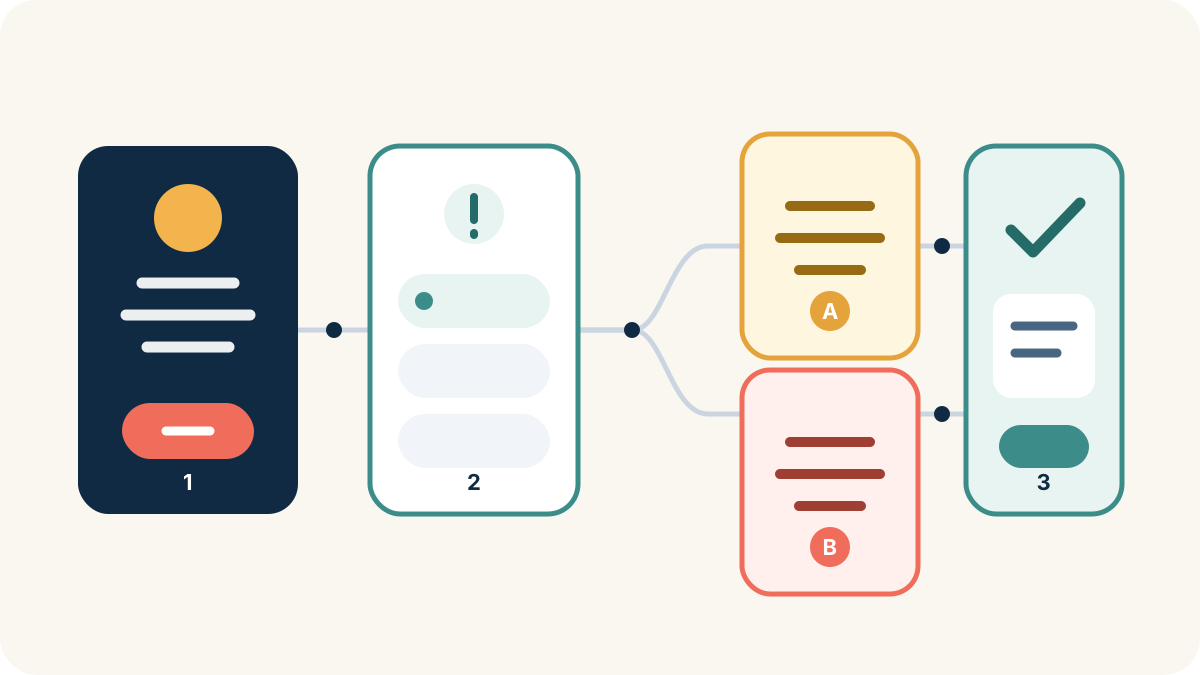
A sales funnel from your bio link transforms a simple click into a guided process that takes the user from interest to action. You don't need a full website or technical knowledge to implement one.
- Define the problem you solve: The funnel starts before the click. Your social content should raise a problem that your bio link solves.
- Create a clear landing page: A headline that connects with the user's pain, a value proposition in 10 words or less, and a single CTA.
- Add a qualifying question: Before showing all your options, ask something simple: 'What's your biggest challenge right now?' This segments the user and personalizes their experience.
- Direct each segment to the right destination: A user who says 'I want more clients' goes to your services page. One who says 'I want to learn' goes to your free resource.
- Capture the contact: Before the user leaves, offer something of value in exchange for their email or WhatsApp.
Related resources
- Complete guide: How to Build a Bio Link Funnel — Step-by-step tutorial with real examples of funnels that convert.
- Link in Bio Landing Page: How to Create One — Give the page one conversion goal, an offer in one line, and a single CTA.
- How to Qualify Leads From Your Bio Link — Filter out the leads that aren't right for you and focus on the ones who will buy.
- How to Make Money With Link in Bio — Real strategies to monetize your audience from day one.
- 5 Mistakes Killing Your Social Media Sales — Avoid the most common mistakes that stop your bio link from converting.
Frequently Asked Questions About Link in Bio
What is a link in bio and what is it used for?
A link in bio is a web page accessible from the link slot in your social media profile. It's used to centralize all your digital destinations — website, store, newsletter, calendar — in a single URL, maximizing the value of that one link that social networks allow.
What is the best free link in bio tool?
For basic functionality, Linktree offers a free plan. However, if you want to capture leads, build funnels, or integrate payments, SellB.io offers a free trial with all advanced features included.
How many links should I put in my link in bio?
The ideal is between 3 and 5 main options. More than 7 links creates choice paralysis and reduces conversion rates. Prioritize based on your monthly goal and hide or remove anything that isn't a priority.
Can my link in bio show up on Google?
Yes. Link in bio pages can be indexed by Google if the tool allows it and if you add quality content. SellB.io generates indexable pages with customizable SEO metadata for each user.
What's the difference between a link in bio and a landing page?
A landing page is designed for one single specific action (buying a product, registering for an event). A link in bio is a hub that offers multiple destinations. The ideal approach is to use the link in bio as an entry point and direct users to specific landing pages for each important action.
Start today
Creating your SellB.io page takes less than 5 minutes. No credit card required, no design skills needed, and you can have your first funnel live before your next post. Every day you wait is a day your followers click and don't convert into clients.
Ready to turn followers into customers?
Sell products, capture leads, take bookings, and guide every visitor from one link.