How to A/B Test Your Bio Link Without Fooling Yourself
A practical guide to bio link A/B testing: choose one hypothesis, split traffic correctly, read conversion confidence, and avoid false winners on low traffic.
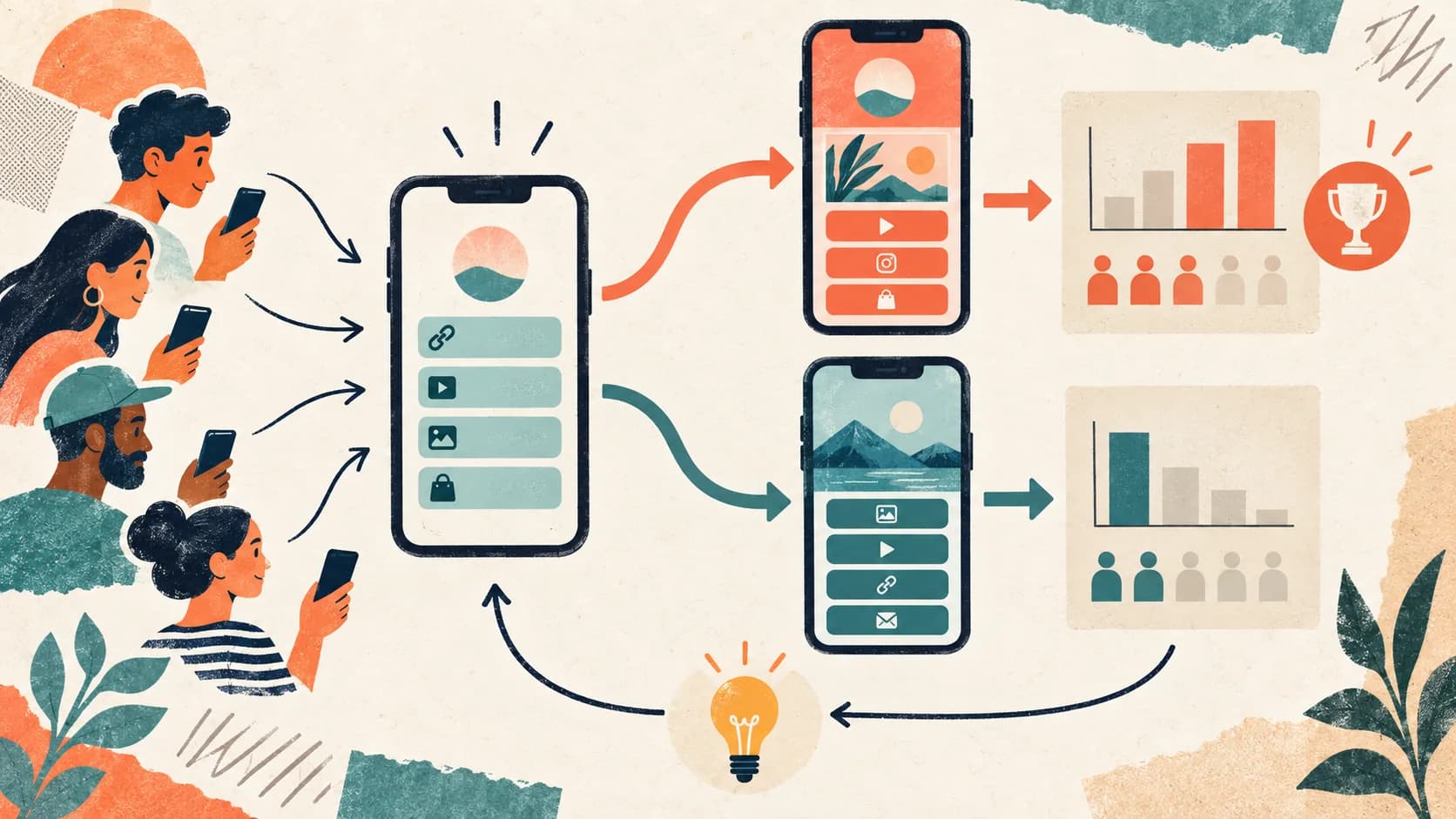
Most bio link “tests” are not tests. Changing a headline on Monday, checking clicks on Friday and comparing them with the previous week mixes the creative change with different traffic, posts and audience intent.
A useful A/B test keeps one URL live, assigns comparable visitors to different versions at the same time and measures the same outcome for every version. The goal is not to manufacture a dramatic uplift. It is to make one decision with less uncertainty.
The short version
Change one meaningful variable, split traffic simultaneously, choose the conversion event before launch, and wait for enough evidence. In SellBio, a test lives on the link: each screen or flow is an arm, traffic weights control exposure, and lead captures are compared per visitor.
What a real bio link A/B test does
A visitor opens one bio link. The testing system assigns that visitor to an arm—A or B, for example—and keeps the assignment stable on later visits. Both arms run during the same period, so a Reel that spikes on Tuesday does not automatically become “proof” that Tuesday’s design was better.
In SellBio, the link is the experiment container. A screen, a flow or a combination of both can be an arm. You choose traffic weights such as 50/50 or 70/30. Assignment is deterministic for the same visitor and link, which reduces the contamination caused by someone seeing A on one visit and B on the next.
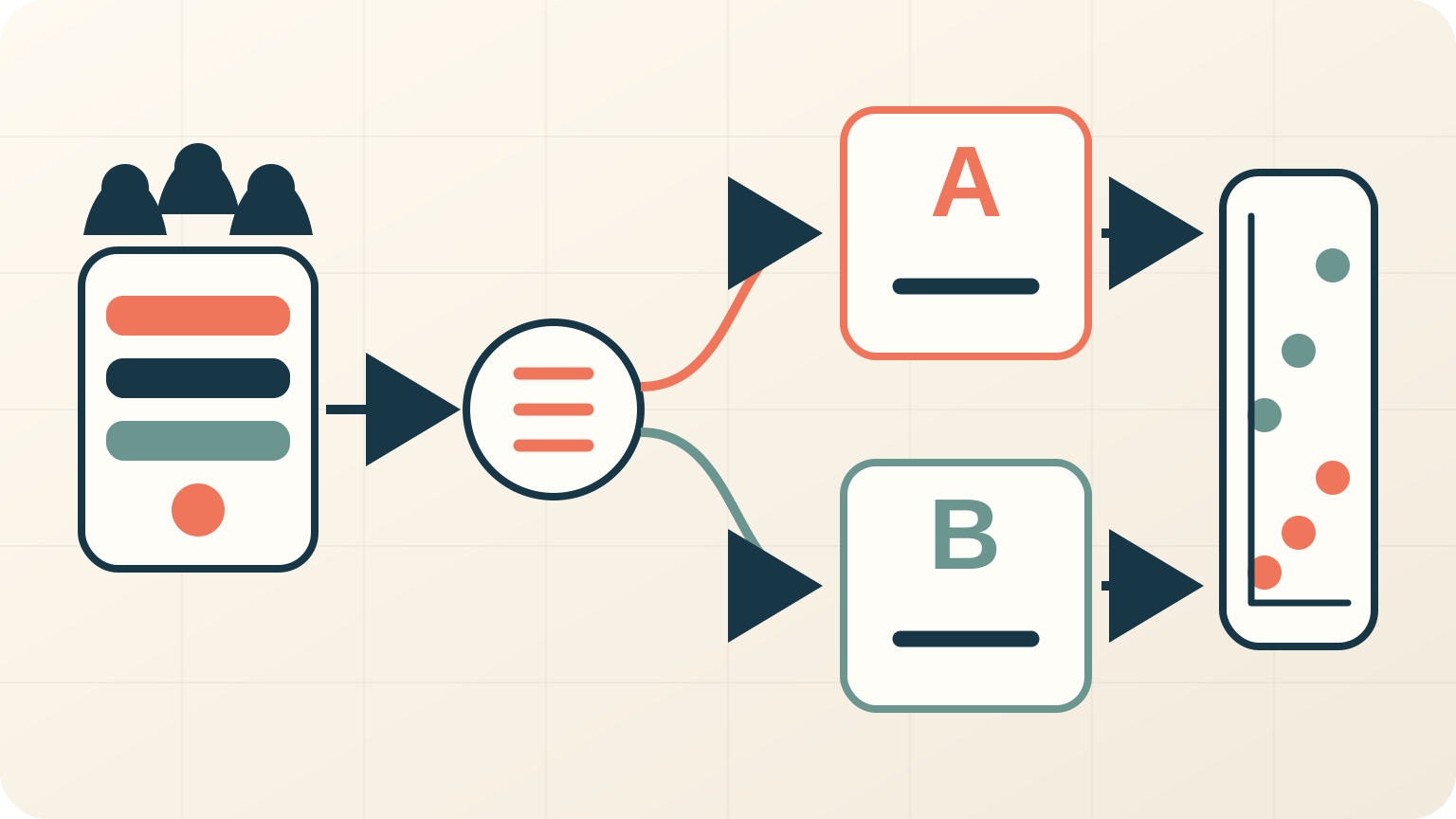
One URL, simultaneous weighted assignment, a stable variant per visitor and one comparable outcome.
This is different from conditional routing. A rule such as “send Instagram visitors to flow A and LinkedIn visitors to flow B” personalizes the journey, but it does not create comparable groups. The source, intent and context changed along with the experience.
Choose a hypothesis, not a redesign
Start with a sentence you can disprove:
If the first screen states the concrete outcome instead of describing the product, more exposed visitors will submit the lead form.
That sentence identifies the audience, the change and the outcome. It also stops the common mistake of changing the headline, offer, image and form at once.
Prioritize tests by how close the variable is to the decision:
- Offer: template versus checklist, free audit versus discovery call.
- First-screen promise: specific outcome versus broad positioning.
- Primary CTA: the action and value visitors expect after the click.
- Funnel shape: direct capture versus a short qualifying flow.
- Friction: required fields, number of steps or an unnecessary choice.
- Visual treatment: image, layout or color, once the offer is already clear.
Button color is easy to change, but easy is not the same as important. A useful principle from Romuald Fons is to work from search and user intent toward the page’s job: first make the offer answer a real need, then optimize its presentation.
Build the test in SellBio
The clean setup is deliberately small:
- Create two screens or flows that differ only in the variable named in the hypothesis.
- Attach both to the same published link.
- Set weights. Use 50/50 when you are comparing two arms and have no reason to protect one.
- Keep UTM-source routing out of the experiment. A source-pinned flow is deterministic personalization, not random allocation.
- Publish and leave the variants unchanged during the measurement window.
- Read exposures, lead captures, flow completions and conversion rate by arm in Analytics.
SellBio currently treats lead_captured as the comparable conversion event across screens and flows. Flow completions appear alongside it, but a single-screen arm has no equivalent completion event. That distinction matters: the dashboard does not let an arbitrary click or purchase silently become the experiment’s success metric.
See the underlying measurement model in SellBio Analytics, compare the approach in SellBio vs Linktree, or apply it to a high-value service journey built for coaches.
Name the test before you launch it
Record four things: hypothesis, exact difference between A and B, primary outcome, and the earliest date you will review the result. If you cannot fill in those four lines, the experiment is not ready.
How to read the result
Conversion rate is simple:
lead captures ÷ exposed visitors × 100
Confidence answers a different question: how surprising would the observed gap be if the two arms actually performed the same? SellBio compares the two leading arms with a two-proportion test and reports confidence bands of 80%, 90%, 95% or 99%. It does not report a confidence level until every compared arm has at least 30 exposures.
Thirty exposures is a guardrail, not proof. Consider this hypothetical result:
| Arm | Exposures | Lead captures | Conversion rate |
|---|---|---|---|
| A | 240 | 28 | 11.7% |
| B | 245 | 41 | 16.7% |
B shows a 43% relative lift, but under SellBio’s current calculation the confidence is only 80%. The effect looks promising; it has not crossed the 95% decision threshold used by the dashboard. Keep the test running or treat the result as directional—not as a proven “43% winner.”
This is why large percentage claims are dangerous. A lift can look huge when the underlying counts are small. Always read the numerator, denominator and confidence together.
Testing with low traffic
Low traffic does not make testing impossible. It changes what is worth testing.
- Test a substantial contrast, not “Get the guide” versus “Download the guide.”
- Use the highest-traffic link that matches the hypothesis.
- Keep only two arms unless traffic is strong; every extra arm dilutes the sample.
- Prefer a valuable downstream event such as lead capture over a shallow page click.
- Set a maximum duration as well as a minimum sample. If the result remains close after a full buying cycle, call it inconclusive and test a stronger idea.
Do not choose a universal duration such as “always run for two weeks.” A creator with 50 daily visitors and a consultant with five weekly visitors are not running the same experiment. Cover at least one normal business cycle and enough traffic for each arm; then use confidence and practical value to decide.
Mistakes that create false winners
Changing an arm after launch. The resulting data describes two different versions under one label. Start a new test instead.
Mixing randomized and source-pinned traffic. Instagram and LinkedIn visitors may have different intent before the page loads. Compare like with like.
Watching only conversion rate. Eight conversions from 20 people and 80 from 1,000 people are not equally reliable observations.
Stopping after the first good day. Repeatedly checking and stopping at a peak increases the chance of selecting noise.
Testing during an abnormal launch without documenting it. Campaign traffic is not forbidden, but the conclusion applies to that campaign audience—not automatically to evergreen traffic.
Declaring “no difference” too early. An inconclusive result may mean the variants are similar, or simply that the test lacks information. Those are different conclusions.
SellBio, Linktree and Stan Store
The three products solve adjacent problems, but their public documentation describes different optimization mechanisms. This comparison was checked against official documentation on September 8, 2026.
| Product | What its public documentation describes | Is it a simultaneous random A/B test? |
|---|---|---|
| SellBio | Multiple screen/flow arms on one link, weighted sticky assignment, per-arm exposures, lead captures, completions and confidence | Yes |
| Linktree | Link-level Insights plus Premium personalization by visitor country or device platform | Personalization is deterministic; we found no documented native random split test |
| Stan Store | Funnels that branch after a customer purchases or skips an offer | No; this is conditional funnel routing, not random assignment |
Linktree’s individual link Insights are useful for before-and-after iteration. Its visitor personalization can show different destinations by country or platform, but those groups are different by design. Stan Store’s Funnels documentation describes purchase/skip branches and upsells, which optimize order flow rather than compare randomly assigned page variants.
The practical takeaway is not that every creator needs A/B testing. If a link receives little traffic, clearer positioning and better distribution will usually beat sophisticated experimentation. But when you do test, do not call sequential edits or conditional paths an A/B test.
A repeatable testing rhythm
Use a small learning log instead of promising yourself a never-ending “growth program”:
- Review the funnel and choose the most valuable weak transition.
- Write one hypothesis and build two controlled arms.
- Launch, record the date and avoid mid-test edits.
- Review counts, conversion rates and confidence together.
- Keep the winner only when the evidence and business value justify it.
- Record what you learned—including inconclusive results—before choosing the next test.
One honest experiment is more useful than ten cosmetic changes. The advantage compounds through better decisions, not through a guaranteed percentage lift.
Explore SellBio plans, choose the page structure that fits your goal, and test the complete journey on mobile before publishing.
Ready to turn followers into customers?
Sell products, capture leads, take bookings, and guide every visitor from one link.