How to Sell Online Courses From Your Bio Link (2026)
Turn your bio link into a course funnel: curriculum structure, drip vs instant access, cohort vs self-paced, payment plans, and the upsell path to premium pricing.
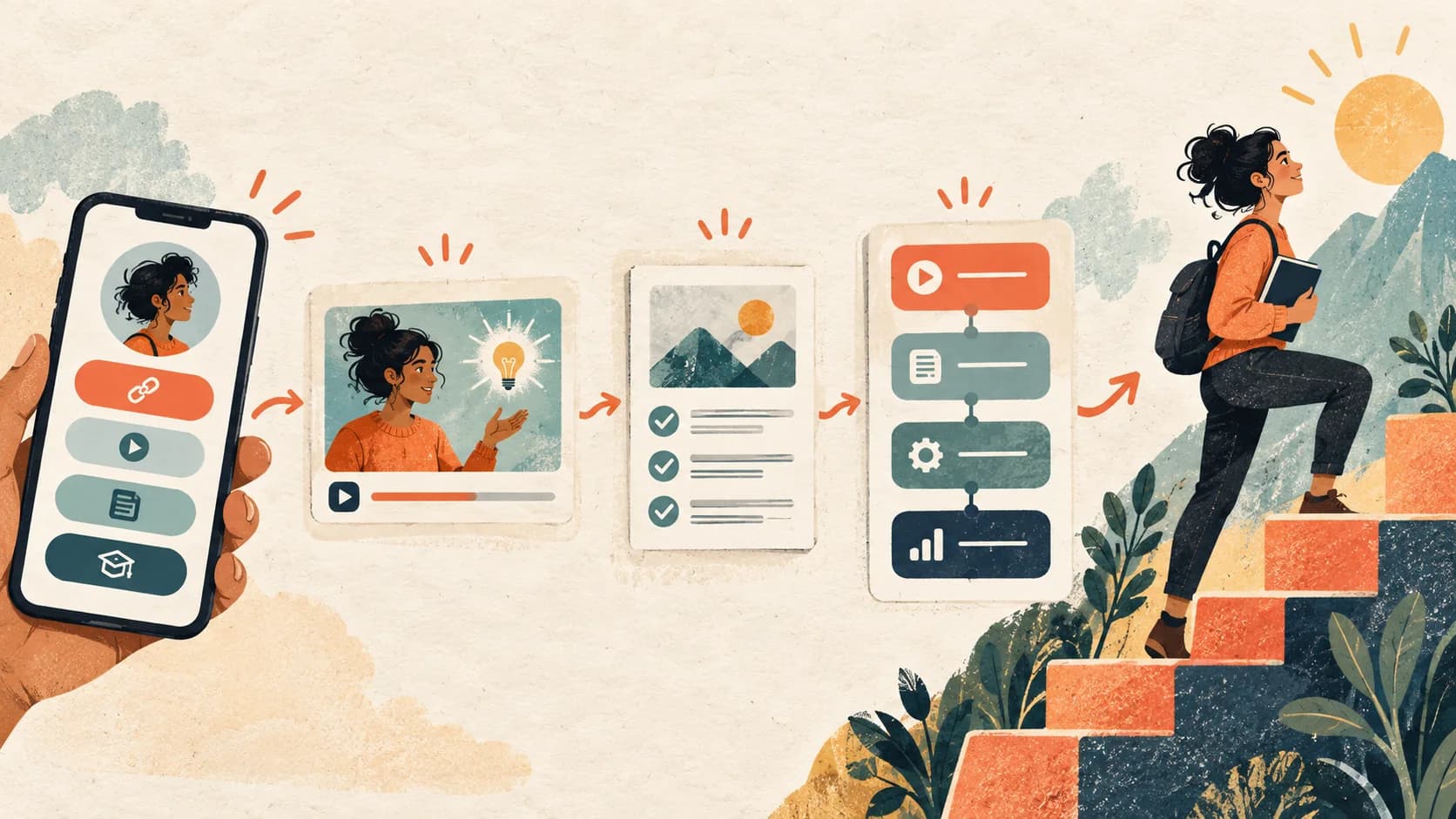
Most creators trying to sell a course from social media make the same structural mistake: they treat their bio link as the checkout counter, when for anything priced above $100, it needs to work as the top of a funnel instead. Get that distinction right and the same audience that ignores a flat link list will enroll in a $297 course. Get it wrong, and you'll wonder why your "link in bio" gets clicks but never conversions.
What you'll learn
How to decide whether your bio link should sell your course directly or capture leads for it, how to structure a curriculum that fits a social-media audience, drip vs instant access, cohort vs self-paced formats, the mini-course-to-full-course upsell ladder, and how payment plans make premium pricing feel accessible.

Why your bio link is the top of the funnel, not the checkout, for premium courses
Every guide to selling courses on Instagram tells you to "optimize your bio" and "drive traffic to your link." Almost none of them tell you what that link should actually do once someone taps it — and the answer changes completely depending on your price point.
Under roughly $100, a bio link can sell directly. A tight mini-course, a template pack with a bonus workshop, a single-session guide — these are impulse-priced enough that a visitor can go from tap to purchase in one sitting. Your bio link is already a strong storefront for that kind of offer.
Above $100 — and especially in the $297-497 range where most real courses live — that same direct-sell approach stops working. Buyers at this price point don't purchase on a cold tap. They need to see a curriculum, understand the outcome, and often want proof that others finished it. Asking for a $297 charge on the first visit is asking too much, too fast.
The fix isn't to abandon your bio link — it's to change its job. For premium courses, your bio link becomes top-of-funnel: it captures the visitor (via a free lesson, a quiz, or a lead magnet) instead of trying to close them immediately. The close happens downstream, after a short nurture sequence has done the work a cold click can't.
The 10-second test
Ask yourself: would a stranger who just discovered you three minutes ago pay this price right now? If yes, sell directly from your bio link. If you hesitated, your bio link's job is to capture the lead, not close the sale.
Structuring a curriculum that works for a bio-link audience
Course creators who came from social media often import a curriculum structure built for search-driven buyers — long, comprehensive, exhaustive. That's the wrong instinct for an audience that found you through a 30-second Reel.
Your curriculum needs to mirror the attention span that got someone to your bio link in the first place. That means:
Modules organized around outcomes, not topics. "Module 3: Advanced Editing Techniques" tells a buyer nothing. "Module 3: Cut Your Editing Time in Half" tells them exactly why they should keep going. Every module title should answer "what do I get," not "what will we cover."
Short lessons over long ones. A social-media audience is trained on short-form content. Ten 8-minute lessons consistently outperform three 30-minute ones for completion rate, even when the total content is identical. Chop your material at natural decision points, not at arbitrary time marks.
A fast first win. The first lesson should deliver a complete, usable result — not throat-clearing about "why this matters." If someone can implement something from lesson one before lesson two even loads, they trust the rest of the course enough to keep paying attention.
One format decision matters more than curriculum length: cohort vs self-paced. A cohort (a group that starts and moves through the material together, often with live calls) drives higher completion and justifies premium pricing through accountability and community — but it only works if you can commit to a live schedule and have enough enrollees to sustain group energy. Self-paced courses scale infinitely and fit a bio-link funnel that's converting daily, but completion rates run lower without external pressure. Most creators selling from a bio link start self-paced (it matches the always-on nature of social traffic) and add a cohort tier later as a premium, higher-priced option once they have proof the content works.
Drip content vs instant access: which keeps students finishing
Once you've structured the curriculum, you need to decide how it's released. This single setting affects completion rates, refund requests, and how "premium" your course feels — more than almost any other decision.
| Instant access | Drip content | |
|---|---|---|
| Best for | Mini-courses, single-outcome content | Multi-week programs, premium pricing |
| Completion rate | Lower — buyers binge the first module, then stall | Higher — pacing mirrors how people actually learn |
| Refund risk | Higher (buyer sees everything, decides it's "too much" or "not enough" in one sitting) | Lower (buyer is still engaged when the refund window closes) |
| Perceived value | Feels like a download | Feels like a program |
Instant access works well for anything under $100 — buyers expect to consume it in one sitting and move on. For anything you're pricing at $297 or above, drip content isn't just a nice-to-have; it's part of what justifies the price. A course that unlocks week by week signals a program, not a folder of videos, and that signal alone reduces refund requests because the buyer is still inside the experience when the refund window closes.
Don't drip your best content too late
A common mistake is saving the most valuable lesson for week four to keep people "engaged." Do the opposite — deliver a genuine win in week one. Drip content paces the depth, not the value. If early modules feel like filler, students churn before they ever reach the good part.
The mini-course-to-full-course upsell ladder
The highest-converting path from a bio link to a premium course rarely starts with the premium course. It starts with a cheap, complete mini-course that proves you can deliver — and upsells into the full program from inside.
Here's the ladder that consistently works:
- Free lead magnet (a checklist, a single lesson, a short quiz) — captured from your bio link, no payment required.
- Mini-course ($27-47) — a tightly scoped, complete win. This is a real purchase decision, but low-stakes enough that a warm follower buys on impulse.
- Full course ($297-497) — offered as an upgrade inside the mini-course, once the buyer has already experienced your teaching style and gotten a result. This is the single highest-converting moment in the entire funnel, because objection #1 ("will this actually work for me?") is already answered by lesson three of the mini-course.
- Cohort or coaching add-on ($997+) — offered to mini-course or full-course completers who want accountability, not more information. This tier sells on relationship, not curriculum.
Each rung reduces the trust gap the next rung has to close. Trying to sell straight from a cold bio-link tap to a $497 course skips three trust-building steps that this ladder handles automatically.
Payment plans: making premium courses feel affordable
Once your course sits at $297 or above, how you present the price matters as much as the price itself. A payment plan — say, 3 payments of $107 instead of one charge of $297 — routinely increases conversion at the same total price point, because buyers evaluate "can I afford this month's payment," not "can I afford the whole thing."
A few rules that hold up in practice:
- Price the plan slightly higher than the one-time option (a small premium, 5-10%, for the convenience of splitting it) — this covers processor fees and mildly nudges price-sensitive buyers toward paying in full.
- Cap it at 2-3 installments for courses under $500. More than that starts to feel like debt, not a course purchase, and increases both refund requests and payment failures.
- Charge the first installment immediately, not on a delay. This filters out buyers who aren't genuinely ready and reduces first-payment failures later.
- Always show both options side by side — the one-time price and the plan. Letting buyers choose their own commitment level is itself a small conversion lift, independent of which one they pick.
If you're layering a cohort or coaching tier on top ($997+), payment plans stop being optional — very few buyers pay four figures upfront to someone they found on social media without a plan available. Payment plans for high-ticket coaching offers deserve their own pricing logic entirely, since the psychology shifts again once you cross into four-figure territory.
Setting up your course funnel: from bio link to enrolled student
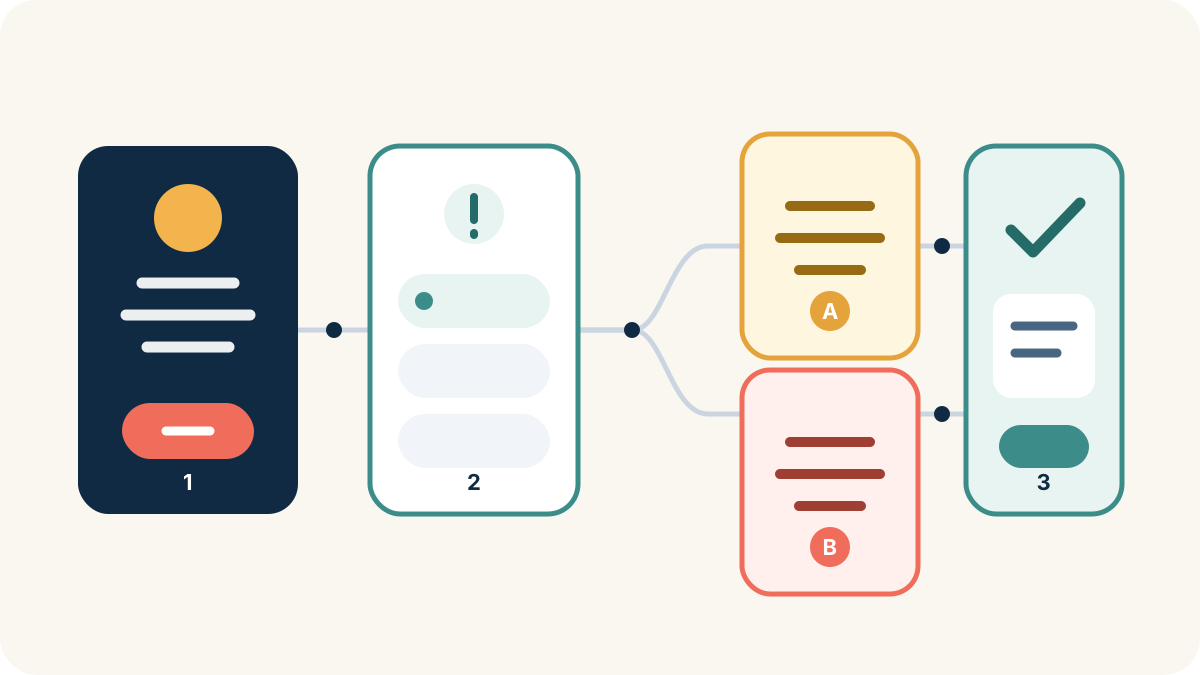
With the curriculum, format, and pricing decided, the funnel itself is straightforward to build:
Step 1 — Lead capture. Your bio link's first job is capturing the visitor, not selling. A free lesson, a short quiz, or a checklist works as the entry point. If you're teaching different skill levels or goals, use conditional logic to route beginners and advanced visitors to different lead magnets — a personalized first touch converts noticeably better than a generic one.
Step 2 — The mini-course offer. Immediately after capture (or as a same-page upsell), present your $27-47 mini-course. This should be the most prominent action on your bio link page after the free offer — not buried under five other links.
Step 3 — The in-course upsell. Inside the mini-course, at the moment the buyer gets their first real result, present the full course. This is a scripted moment, not an afterthought — write the exact transition line you'll use before you ever record the lesson.
Step 4 — Automated enrollment. Whichever course tier someone buys, access should be automatic — no manual emailing of login details. If a buyer pays at 11 PM and gets access at 11 PM, they start consuming immediately, which is when motivation is highest.
Step 5 — The cohort/coaching offer. Reserve this for people who've already completed (or are actively working through) the full course. Pitching it earlier just adds noise to a funnel that's still trying to build trust.
Mistakes that stall course sales from social audiences
Selling the $297 course directly from a cold bio-link tap. This is the single most common failure. If your bio link's only option is "buy my $297 course," you're asking a stranger to make a considered purchase decision in the time it takes to read a landing page on their phone. Add a cheaper or free entry point first.
Instant-releasing a premium course. If you're charging program pricing, deliver it as a program. Dumping all content at once at a $297+ price point causes buyers to binge, feel like they've "seen it all" by day two, and request refunds before they've implemented anything.
No clear next step after the mini-course. If someone finishes your $37 mini-course and there's no obvious upgrade path, you've left your highest-intent moment on the table. The upsell to the full course should be baked into the last lesson, not something you announce later in a newsletter.
One price, no plan. Especially above $200, offering only a single lump-sum price quietly filters out buyers who wanted to say yes but couldn't justify the full amount today. A payment plan option costs you nothing to offer and consistently recovers sales you'd otherwise lose.
Treating the cohort tier as the default. Cohorts are powerful, but they cap your capacity and require a live schedule. Building your whole funnel around cohort enrollment means every non-cohort visitor — the majority of your bio-link traffic — has nowhere to go. Keep self-paced as the default path and use cohorts as a premium option for those who want more.
Turn your audience into your first students
You don't need a finished six-module curriculum or a fancy cohort platform to start. You need one tightly scoped mini-course, a bio link that captures before it sells, and a single upsell moment that turns a $37 buyer into a $297 student. Everything else — the drip schedule, the payment plans, the cohort tier — gets built once you've proven that first step converts.
The creators earning consistent course revenue from social media didn't start with a perfect curriculum. They started by giving their bio link one clear job at a time — and that's a structure your existing audience already knows how to move through.
Explore SellBio plans, choose the page structure that fits your goal, and test the complete journey on mobile before publishing.
Related reads
- How to sell digital products from your bio link — The broader playbook for templates, ebooks, and mini-courses priced under $100
- How to build a bio link funnel — The funnel mechanics that power the lead-capture step above
- SellBio vs Stan Store — Compare features for course creators selling from a bio link
Ready to turn followers into customers?
Sell products, capture leads, take bookings, and guide every visitor from one link.